
Key Takeaways
- SXT, GT, R/T, Scat Pack, and SRT have been used across Dodge models, but they do not form a universal trim ladder.
- The 2026 Charger uses R/T and Scat Pack names for its gas models, while Daytona Scat Pack models are fully electric.
- Ram trucks use a separate trim system, including Tradesman, Big Horn/Lone Star, Laramie, Rebel, RHO, Limited, and Tungsten.
- The Challenger ended after the 2023 model year, while Hornet production is currently paused indefinitely.
- Dodge trim names can vary by model and year. Refer to the Dodge window sticker to check the actual trim level by VIN.
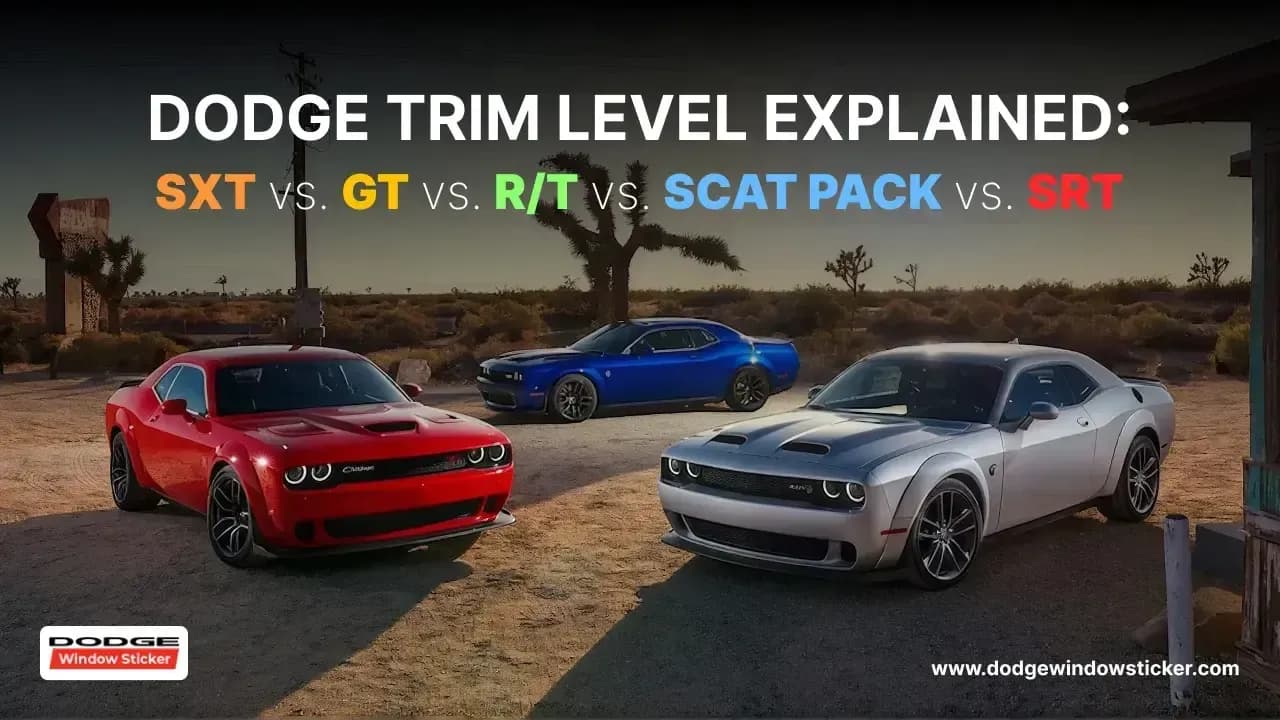
Badges like SXT, GT, R/T, Scat Pack, and SRT appear on many Dodge vehicles, but they do not always mean the same thing. A GT, for example, can describe a sporty V6 car or a different equipment level on another Dodge model. Dodge has also changed its trim names and powertrains over time. This guide explains the major Dodge trim names and how to find Dodge trim by VIN.
What Do Dodge Trim Levels Actually Mean?
A trim level is a predefined version of a vehicle with its own combination of equipment, features, and sometimes powertrain options. It can affect items such as the engine, wheels, seats, technology, suspension, and other factory equipment. Paint colors and many optional packages are separate choices.
Dodge has often used trim levels to separate vehicles by both features and performance. On models such as the Charger and Challenger, moving to a higher performance trim could also mean a larger engine, stronger brakes, or other hardware changes.
However, the meaning of a trim name depends on the model and model year.
The Classic Dodge Performance Ladder: SXT → GT → R/T → Scat Pack → SRT
Dodge trim levels have used SXT, GT, R/T, Scat Pack, and SRT at different points in its performance-oriented lineup. On the Charger and Challenger, these names could be viewed as a rough progression, but they were never a universal Dodge trim ladder. Their equipment and powertrains also changed across different models and years.
SXT
SXT was commonly positioned as an entry-level or lower-priced Dodge trim. On many Charger and Challenger model years, it used the standard V6 engine and offered the core equipment expected from the vehicle.
The exact features varied by model year. SXT is no longer part of the current Charger lineup, but it remains common on used Dodge vehicles.
GT
GT generally added sportier styling and equipment compared with lower trims. Depending on the vehicle, that could include larger wheels, exterior changes, upgraded suspension components, or additional technology.
On many older Charger and Challenger versions, the GT retained the V6 engine used in lower trims. That makes the badge a poor indicator of power by itself.
R/T
R/T stands for Road/Track and has traditionally identified a more performance-focused Dodge model. On many Charger and Challenger versions, an R/T used a V8 engine and added performance-oriented equipment.
The meaning is not universal, however. The 2026 Charger R/T, for example, uses a 3.0L twin-turbo SIXPACK inline-six rather than a HEMI V8. This is one reason the model year matters when interpreting an R/T badge.
Scat Pack
Scat Pack is a performance name associated with Dodge's muscle-car heritage. The name originated with Dodge's performance marketing in the late 1960s.
On recent Charger and Challenger models, the Scat Pack was associated with the 6.4L 392 HEMI V8 and additional performance equipment. The current 2026 Charger uses the Scat Pack name differently, pairing it with a high-output version of the 3.0L twin-turbo SIXPACK engine.
SRT
SRT stands for Street and Racing Technology. The name originated as a Chrysler performance engineering group and later became associated with some of the highest-performance Dodge vehicles.
Recent SRT Dodge models have included vehicles such as the Challenger SRT Hellcat and Durango SRT Hellcat. These versions can include higher-output engines, upgraded cooling, brakes, suspension components, and other performance hardware.
Note: SXT, GT, R/T, Scat Pack, and SRT should not be treated as a fixed Dodge-wide hierarchy. Their meaning depends on the specific model and model year.
Dodge Trim Levels by Model
Dodge uses different trim structures across its vehicles. Some models follow familiar performance naming, while others use completely different combinations. The sections below separate current 2026 models from discontinued vehicles that are still common in the used-car market.
Dodge Charger Trim Levels
The 2026 Charger has a very different trim structure from the previous generation. Its gas lineup includes R/T, R/T Plus, Scat Pack, and Scat Pack Plus, while the electric lineup includes Daytona Scat Pack and Daytona Scat Pack Plus. The Charger is also available as both a two-door coupe and a four-door sedan.
The gas R/T uses a 3.0L twin-turbo SIXPACK inline-six producing 420 horsepower. The gas Scat Pack uses a higher-output version producing 550 horsepower. The electric Daytona Scat Pack uses a dual-motor all-wheel-drive powertrain.
SXT and GT
SXT and GT are not offered on the current-generation 2026 Charger. They remain relevant when researching older Chargers, where both names were used as lower- or mid-level trims.
The previous Charger generation used a much broader trim structure. Depending on the model year, shoppers could encounter SXT, GT, R/T, Scat Pack, and SRT Hellcat badges.
Dodge Challenger Trim Levels
The Dodge Challenger was discontinued after the 2023 model year, so its trim levels are now relevant primarily to used-car shoppers and owners.
Recent Challengers were offered in trims including SXT, GT, R/T, R/T Scat Pack, SRT Hellcat, and SRT Hellcat Redeye, with Widebody versions and various special editions available during the final years. Dodge also introduced Last Call editions to mark the end of Challenger production.
Dodge Durango Trim Levels
The 2026 Durango has a more complex lineup than a simple GT-to-R/T-to-SRT progression. Current versions include GT, GT Plus, GT HEMI V8, R/T 392, and SRT Hellcat, along with higher-equipment versions and special editions.
The GT uses the 3.6L Pentastar V6, while GT HEMI V8 versions use the 5.7L HEMI V8, producing 360 horsepower. The R/T 392 moves to the 6.4L HEMI V8, producing 475 horsepower and 470 lb-ft of torque. The SRT Hellcat uses a supercharged 6.2L HEMI V8 with 710 horsepower.
Dodge Ram Trim Levels: A Different System
Ram trucks do not follow Dodge's traditional SXT, GT, R/T, Scat Pack, and SRT naming structure. Searches for “Dodge Ram trim levels” or “Dodge Ram 1500 trim levels” usually refer to Ram trucks, which have their own trim system.
Ram became a separate brand from Dodge in 2010, although “Dodge Ram” remains a common term for these trucks. Current Ram 1500 versions include several work, lifestyle, off-road, performance, and luxury trims.
Common 2026 Ram 1500 trims include:
- Tradesman — the entry-level work-oriented trim.
- Express — a value-focused version with sportier styling.
- Warlock — an off-road-oriented model with a more aggressive appearance.
- Big Horn / Lone Star — a higher-equipment trim, with Lone Star used primarily for the Texas market.
- Laramie — adds more premium interior and technology features.
- Rebel — the off-road-focused 1500 trim.
- RHO — the high-performance off-road model using the Hurricane High-Output engine.
- Limited and Limited Longhorn — premium and luxury-oriented versions.
- Tungsten — the top luxury-oriented 1500 trim.
The exact lineup can change by model year. The 5.7L HEMI V8 also returned to the Ram 1500 for 2026 after being unavailable in the 2025 lineup. The RHO now occupies the high-performance position previously held by the TRX.
Dodge Hornet Trim Levels
The Dodge Hornet was sold for the 2023 through 2025 model years, and production is currently paused indefinitely. Some new Hornet inventory may still be available, but the model is increasingly relevant to used-car shoppers.
The Hornet lineup consisted of GT, GT Plus, R/T, and R/T Plus trims. The GT used a 2.0L turbocharged four-cylinder producing 268 horsepower. The R/T was a plug-in hybrid combining a 1.3L turbocharged engine with an electric motor for up to 288 horsepower.
The Hornet also demonstrates why Dodge trim names do not follow one universal system. It used GT and R/T badges but did not use the SXT, Scat Pack, or SRT structure found on some Dodge performance cars.
How to Find Dodge Trim by VIN
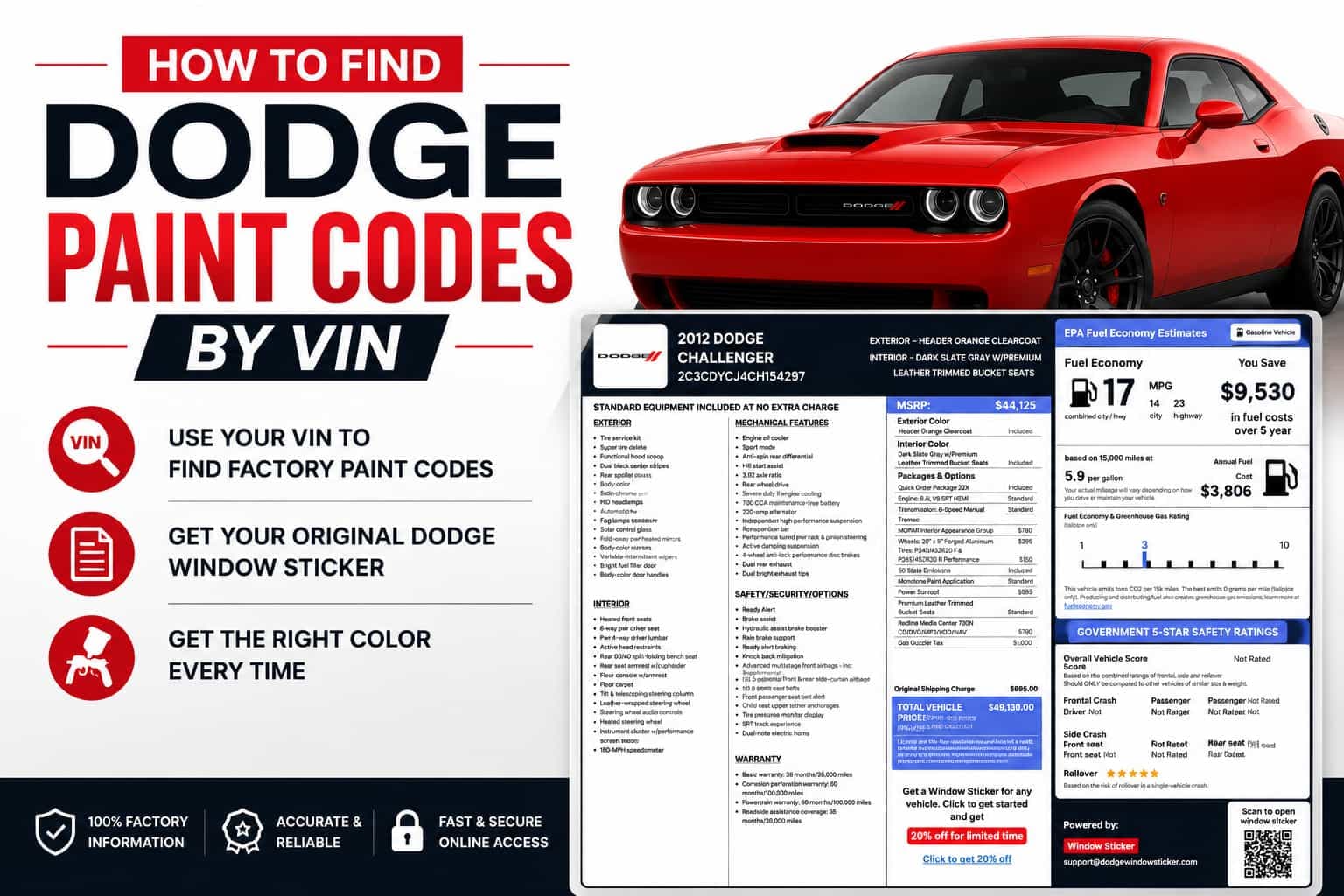
To find the trim level by VIN, you can use a dedicated service that can retrieve the window sticker to check the actual trim.
Step 1: Find the VIN
Check the driver’s side door jamb, engine bay, or on the vehicle’s paperwork like the bill of sale, insurance, and title.
Step 2: Enter the VIN
Visit the Dodge Window Sticker and click the form, then enter the Dodge VIN you want to check.
Step 3: Get the Window Sticker
Wait a few seconds for the sticker to generate. Then, you may proceed to payment to see the Dodge trim level.
So, Know About the Dodge Trim?
Dodge trim names combine equipment, styling, and performance, but their meaning changes by model and model year. A GT, R/T, or Scat Pack badge does not guarantee the same engine or equipment across the entire Dodge lineup. If you are still wondering what trim is my car by VIN, you can use the Dodge window sticker to check the actual trim level.
Frequently Asked Questions About Dodge Trim Levels
What are the Dodge Charger trim levels?
The latest Dodge Charger lineup offers both gas-powered and electric models in two-door and four-door body styles. Gas-powered models include the R/T, R/T Plus, Scat Pack, and Scat Pack Plus, while the electric lineup includes the Daytona Scat Pack and Daytona Scat Pack Plus. Older Chargers also used trims such as SXT, GT, and SRT Hellcat, which remain relevant when researching used models.
What are the Dodge Durango trim levels?
The 2026 Dodge Durango lineup includes GT, GT Plus, GT HEMI V8, R/T 392, and SRT Hellcat variants, along with higher-equipment versions and special editions. The GT uses a 3.6L V6, while GT HEMI V8 models use the 5.7L HEMI V8. The R/T 392 uses a 6.4L HEMI V8, while the SRT Hellcat uses a supercharged 6.2L HEMI V8.
What are the Dodge Ram trim levels?
Modern Ram trucks, which were previously marketed as Dodge Ram, are offered in a wide range of trim levels for work, daily driving, off-road use, and luxury. The Ram 1500 lineup ranges from work-focused trims such as the Tradesman to premium configurations such as the Limited and Tungsten, with models such as the Rebel and RHO serving more specialized purposes.
What are the trim levels for the Dodge Challenger?
The Dodge Challenger's recent lineup included core trims such as the SXT, GT, R/T, R/T Scat Pack, and SRT Hellcat, along with Widebody versions and other specialized performance models. The final model years also brought Last Call editions, including the 1,025-horsepower Dodge Challenger SRT Demon 170. Challenger production ended after the 2023 model year.
What's the difference between R/T and Scat Pack?
On recent Dodge Charger and Challenger models, the main difference between the R/T and Scat Pack was typically the powertrain and performance equipment. The R/T commonly used a 5.7L HEMI V8, while the R/T Scat Pack used the larger 6.4L (392-cubic-inch) HEMI V8. On the final Charger and Challenger generations, the 5.7L R/T produced around 370–375 horsepower depending on the model, while the 392 Scat Pack produced 485 horsepower.
Is SRT higher than Scat Pack?
On recent Charger and Challenger models, SRT generally represented a higher-performance level than R/T Scat Pack. However, the two did not always use the same engine. The R/T Scat Pack used the 6.4L (392-cubic-inch) HEMI V8, while SRT versions such as the SRT Hellcat used a supercharged 6.2L HEMI V8 with substantially higher output. SRT models also added performance hardware and equipment beyond the Scat Pack.
Does Dodge still make a Hellcat?
Dodge still offers a Hellcat in the Durango lineup. The Durango SRT Hellcat uses a supercharged 6.2L HEMI V8 producing 710 horsepower. Hellcat versions of the Charger and Challenger ended after the 2023 model year. Any discussion of a future Hellcat-powered Charger should be treated as speculation unless Dodge officially announces one.
.webp&w=1920&q=75)