
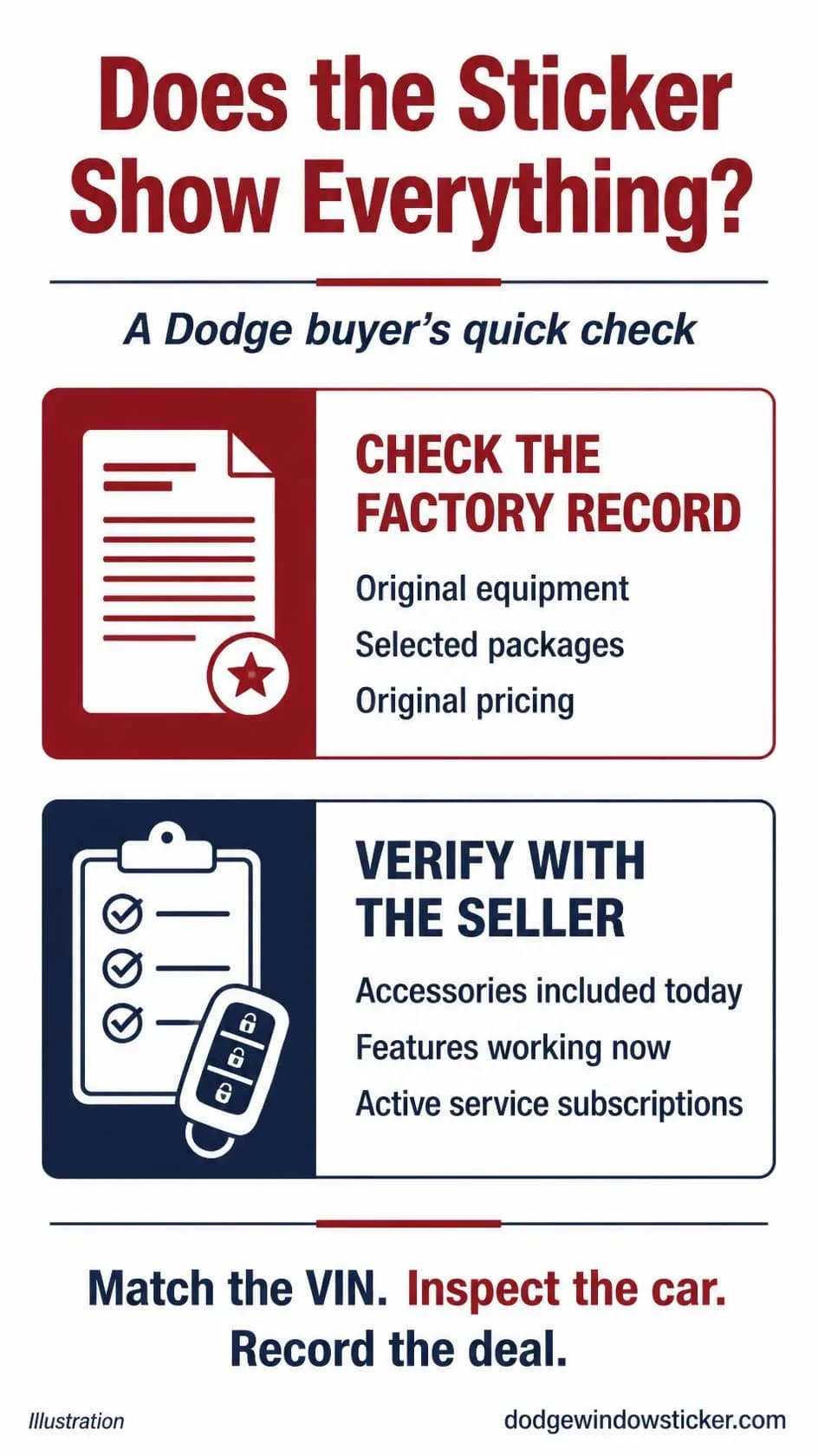
This simple answer is no. A Dodge window sticker helps identify original equipment, but it does not confirm everything included in a used-car sale. Keys, removable accessories, later upgrades, and active subscriptions need separate checks.
Think of a used Challenger advertised with an equipment package and two sets of wheels. The sticker may help you research the package. Only the seller can confirm whether both wheel sets come with the purchase.
Key Takeaways
- Use the sticker to check original equipment claims.
- Inspect the car to see what is present and working.
What Does “Included With the Car” Actually Mean?
Before comparing documents, separate these three questions:
| What You Want To Know | Where To Check |
|---|---|
| What equipment was recorded when the Dodge was new? | A vehicle-specific window sticker or factory record |
| What is fitted and working today? | The car itself, a demonstration, and an inspection |
| What will the seller hand over? | An agreed list of accessories, keys, and extras |
← Scroll horizontally to see more →
These answers can differ without anyone being dishonest. An owner may have replaced the original wheels or removed an accessory years ago. The problem starts when an advertisement treats original equipment as proof of what is available now. If an item matters to your decision, ask the seller to show it.
For example, “original wheels included” should mean a set the seller can identify and supply. A factory wheel description on a sticker does not establish that those wheels are still available.
What Can a Dodge Window Sticker Help You Check?
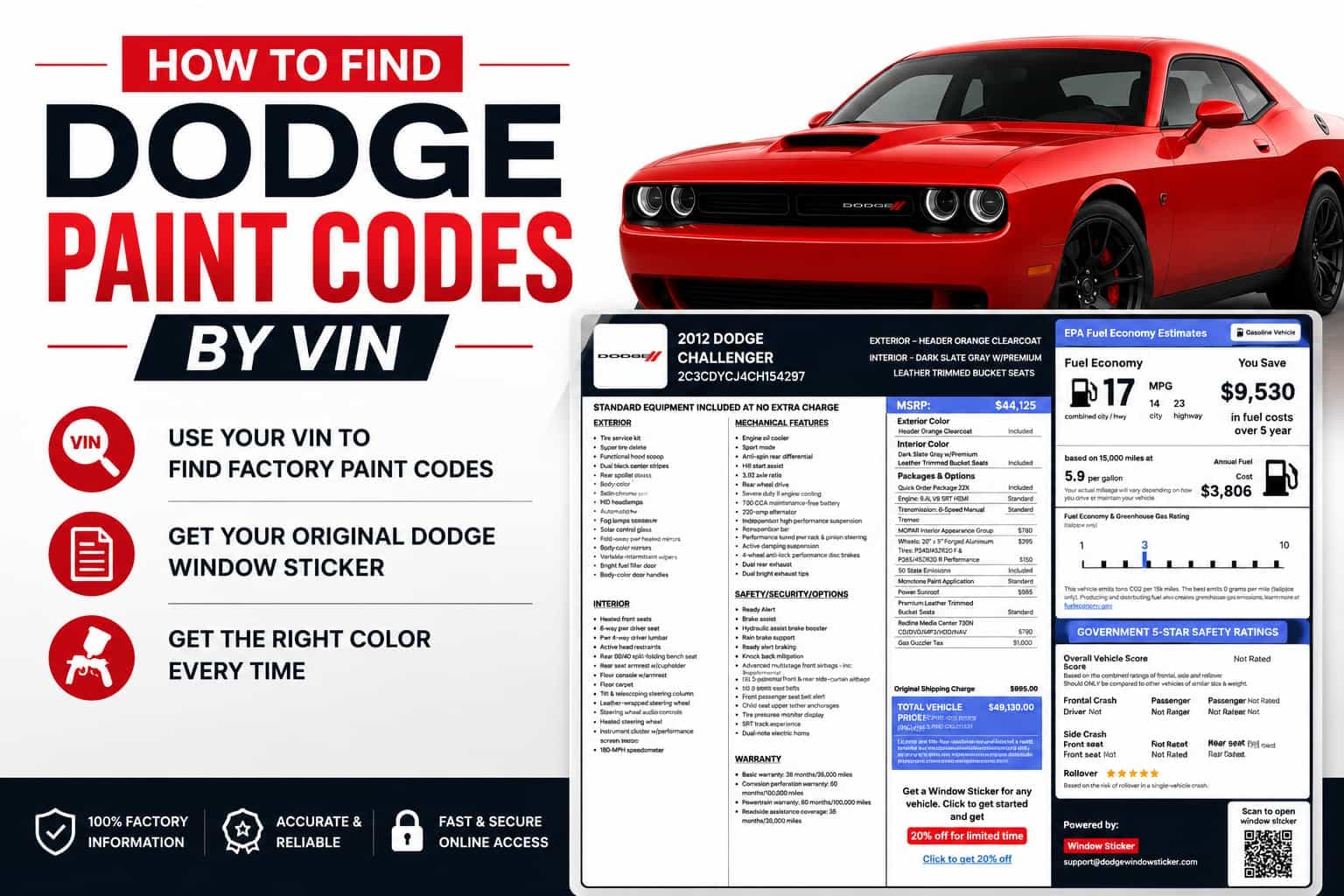
A window sticker provides a starting point for comparing a Dodge with its advertisement. Depending on the document and available records, it may show:
- Standard equipment.
- Selected options and packages.
- Original exterior and interior colors.
- Original suggested prices.
Match the VIN first. A sticker for another Charger with the same trim badge does not establish the equipment on the car you are viewing. Then focus on the claims that affect your choice. If the listing highlights a particular package, find that package in the vehicle’s record before discussing whether it justifies the asking price.
If you need a document to begin that comparison, you can review the sample and available information on the Dodge window sticker lookup page. Check whether the information you need is available for your vehicle.
Avoid reading an original option price as its value today. A feature’s usefulness, condition, and importance to you are separate questions from what it cost when new.
Does a Missing Feature Mean the Car Never Had It?
No. Missing information does not confirm that a feature was absent. Check these possibilities first:
| Why You Might Not See It? | What To Check? |
|---|---|
| It was standard equipment | Read the standard-equipment section |
| It belonged to a package | Check the package contents for that model year and configuration |
| Part of the sticker is cropped | Request the full document |
| A recreated document lacks the detail | Ask its provider whether the information is available |
← Scroll horizontally to see more →
A brochure can explain what Dodge offered, but it cannot prove what one specific car received. If the document itself is unclear, you can check if a replacement Dodge window sticker is the same as the original.
Before paying extra for a claimed feature, ask for vehicle-specific evidence and check the car. An unexplained blank is a reason to investigate, not a definite yes or no.
Which Items Should You Check With the Seller?
Use this checklist for loose items and extras. It is not a list of equipment supplied with every Dodge.
| Item | What to confirm |
|---|---|
| Keys and remotes | How many working keys you will receive |
| Floor mats and cargo accessories | Which pieces are included |
| Spare wheel or tire-repair equipment | What is actually in the storage area |
| Wheel-lock key, where needed | Whether the seller can locate it |
| Extra wheels or removed original parts | Exactly which parts come with the sale |
| Added dash camera or other accessories | Whether they stay with the car |
← Scroll horizontally to see more →
Ask the seller to bring included items to the viewing. “There is another key somewhere” leaves a question unresolved; seeing and testing that key answers it.
Also ask: “Will anything shown in the listing be removed before collection?”
This matters when photographs show an accessory the seller wants to keep. A visible item and an included item are not necessarily the same thing.
For remote purchases, request current photos of the agreed extras together. Photos help clarify the arrangement, although you should still check the items at handover.
What About Dealer Extras and Owner Upgrades?
A genuine Dodge or Mopar accessory may have been fitted after the car left the factory. Its branding alone does not tell you when it was installed. Different records answer different questions:
| Type of Addition | Useful Supporting Record |
|---|---|
| Dealer-installed accessory | Dealer invoice or separate addendum |
| Owner-installed upgrade | Purchase receipt and installation record |
| Replaced original part | Replacement invoice or explanation from the seller |
| Extra part offered with the sale | Written description of the included item |
← Scroll horizontally to see more →
Suppose a used Durango has an accessory that does not appear on its factory record. Ask who fitted it, whether it works, and whether it is included in the price. If an upgrade matters to you, request a demonstration. Receipts can explain an installation, but they do not establish its current condition.
Missing paperwork does not automatically make an accessory unsuitable. It means the seller’s explanation has less documentary support. Decide whether an inspection can answer the remaining question before relying on the upgrade’s advertised value.
How Do You Check Whether Listed Features Still Work?
Choose the features you will actually use and ask for a demonstration during the viewing. Start with ordinary controls that can be checked safely while parked.
| Feature you care about | Practical check |
|---|---|
| Heated seats | Ask the seller to demonstrate operation |
| Seat adjustments | Try the available positions and controls |
| Audio system | Listen through the available sources and speakers |
| Parking camera | Ask to see its operation in a safe setting |
| Air conditioning | Have cooling operation demonstrated |
← Scroll horizontally to see more →
Follow the vehicle’s instructions, and leave unfamiliar systems and specialist assessments to a qualified inspector. A switch or screen menu does not prove that a feature works. If the seller cannot demonstrate something, record it as unverified instead of assuming it is fine.
Do not test collision-avoidance equipment by creating a dangerous situation. It’s recommended to have an independent mechanical inspection; that remains useful even when the equipment paperwork looks reassuring.
Are Subscriptions and Warranty Coverage Still Included?
A service mentioned when a Dodge was new may not be active when you buy it used. Treat access and coverage as separate checks.
| Item Mentioned By The Seller | What To Verify |
|---|---|
| Connected services | Current availability for the vehicle |
| Paid subscription | Charges, account setup, and transfer requirements |
| Original manufacturer warranty | Remaining coverage using current vehicle details and documents |
| Separate service contract | Provider, terms, and whether it can transfer |
← Scroll horizontally to see more →
For connected services, contact the relevant provider before counting the service as part of the car’s value. A demonstration through the seller’s account does not establish what access you will have.
For warranty claims, request the current documents. Check applicable dates, mileage limits, and conditions with the provider rather than relying on wording from the original sticker. If the seller cannot confirm the status, keep it on your unresolved list. Do not treat “it should still be covered” as the same answer as verified remaining coverage.
What Should You Do When the Listing and Sticker Disagree?
A mismatch deserves a specific question. It does not automatically prove the advertisement is wrong or the car has a serious problem. Use the difference to decide what evidence you need next:
| Mismatch | Useful next step |
|---|---|
| Listing names a package you cannot find | Ask for vehicle-specific supporting information |
| Wheels differ from the original description | Ask when they changed and which set is included |
| Advertised feature is absent from the car | Ask the seller to correct or explain the listing |
| Sticker VIN differs from the vehicle | Request the correct document before comparing equipment |
← Scroll horizontally to see more →
If the explanation raises questions about the Dodge’s past, running a Dodge VIN check can help investigate available history records.
A history report may contain recorded title, mileage, or damage information, depending on coverage. It cannot establish why every accessory changed, and an unreported incident may still have happened. Use history records to guide further questions. Keep condition checks with the inspector and included-item questions with the seller.
Make a Simple Collection Checklist
Keep one short list rather than separate notes across messages. Give each important item a clear status:
| Status | Meaning |
|---|---|
| Confirmed | You have checked the item and agreed it is included |
| Unverified | You still need evidence or a demonstration |
| To be supplied | The seller has agreed to provide it later |
| Excluded | It will not come with the car |
← Scroll horizontally to see more →
For anything to be supplied later, name the item, who will provide it, and the agreed date. “Missing accessory to follow” is less useful than identifying the actual accessory. At collection, review the unresolved entries first. This keeps attention on what still needs an answer instead of repeating checks you have already completed.
Pro tip: Save the listing and its photos before your visit. You can refer back to the version that informed your questions if the advertisement changes.
A Message You Can Send Before Collection
Use this as a starting point:
Please confirm how many working keys come with the Dodge, which removable accessories and extra parts are included, and whether anything in the listing photos will be removed. Please also name any items you have agreed to supply later and when they will be available.
Add specific items you discussed, such as an extra wheel set or a replacement key. Avoid asking only whether “everything” is included; that word can mean different things to each person.
Keep the reply with your sale documents and check it against the handover. If the arrangement changes, ask for the updated details before completing the purchase.
Check the Record, Then Confirm the Deal
A Dodge window sticker is useful for researching original equipment. Your viewing and agreement with the seller establish what you are buying today. Finish with a clear answer to one question: “Which items am I receiving, and what still needs checking?”
FAQ About What a Dodge Window Sticker Will Tell You
Does “fully loaded” mean a Dodge has every option?
No. Treat “fully loaded” as a seller’s description that needs clarification. Ask which features and packages the phrase refers to, then compare those claims with records for that Dodge and inspect the car. Do not assume every option offered for the model was fitted or remains on the vehicle today.
Can the seller’s photos replace an equipment check?
Photos help you prepare questions, but they do not confirm that pictured items remain with the car or work properly. Ask whether the images show its current condition. At the viewing, compare the vehicle with the listing and confirm any accessories that will be removed or supplied separately before collection.