


Before buying a Dodge Challenger with over 100,000 miles, check its service history, original configuration, current condition, and immediate repair costs. The odometer is a starting point, not a verdict on whether the car is worth buying.
A cheaper Challenger can lose its price advantage if maintenance has been postponed. Equally, a higher-mileage example deserves consideration when the records are useful, an independent inspection is reassuring, and the total cost fits your budget.
Key takeaways
- Verify the engine, transmission, and equipment before comparing prices.
- Separate documented maintenance from work the seller only says was done.
- Get repair estimates before deciding whether the asking price is attractive.
Is 100,000 Miles Too Much for a Challenger?
There is no single mileage number that tells you how much useful life a Challenger has left. Two cars showing similar mileage can have different service histories, repairs, modifications, and current problems. Ask what the car needs now instead of relying on “these engines last forever” or “anything over 100K is worn out.”
| Question | Why it matters? |
|---|---|
| Was maintenance kept up? | Helps identify work that may have been postponed |
| What major repairs were completed? | Shows which problems were addressed and how |
| Has the car been modified? | Adds questions about installation, use, and future servicing |
| What does an inspection find? | Establishes present concerns that records cannot settle |
← Scroll horizontally to see more →
An older, lower-mileage Challenger also needs age-related checks. Low mileage does not make aging tires, leaks, or neglected maintenance disappear. Your decision should rest on the particular car and the evidence available, rather than a promise about how many more miles it will cover.
Confirm Which Challenger You Are Actually Buying
Before comparing two listings, establish the model year, trim, engine, transmission, and drivetrain. A trim badge, replacement hood, or seller’s description is not enough to confirm the factory configuration. Use a Dodge window sticker to compare available original equipment information with the advertisement.
| Listing Detail | Why Checking The Factory Record Helps |
|---|---|
| Engine and transmission | Keeps your maintenance and price comparisons relevant |
| Trim and packages | Helps investigate equipment claims that influence the price |
| Original wheels and other options | Provides a starting point for discussing later changes |
| Comfort equipment | Helps you identify features to check during the viewing |
← Scroll horizontally to see more →
Review the sample and available information on our Dodge window sticker lookup page. Confirm coverage for the vehicle and the details you need before ordering. Match the VIN on the record to the car. A document for a similar Challenger does not establish this vehicle’s equipment.
The sticker describes available original information. It does not prove that the original engine, wheels, or other parts are still fitted, or that a listed feature works today.
Ask for Service Records Before Traveling
Request records early enough to review them before arranging a viewing. A stack of receipts is more useful when you can connect each document to a date, mileage, and the correct vehicle.
Start with these questions:
- When was the last oil change?
- Which scheduled services have been completed?
- Has the engine or transmission needed major repairs?
- Are there unresolved problems or recurring warning lights?
- Which maintenance items does the seller expect next?
“Recently serviced” can mean several things. Ask what the workshop actually did. An oil change and a broad maintenance visit are not interchangeable. Look for continuity rather than demanding a receipt for every mile. A missing invoice does not prove neglect, but a long unexplained gap gives you less evidence to rely on.
Pro tip: Ask the seller to send the most recent invoices with the current odometer photo. You can compare the dates and mileages before spending time on a viewing.
Which Car Maintenance Matters Around 100,000 Miles?
Use the schedule for the Challenger’s exact model year and engine. Do not assume that every Challenger needs the same work at precisely 100,000 miles. The goal is to find out what is due, what has already been done, and what remains undocumented.
| Maintenance Area | Useful Questions for the Seller Or Shop |
|---|---|
| Oil and filter changes | Do the records show servicing at the applicable intervals? |
| Spark plugs | When does this engine’s schedule call for replacement, and is it documented? |
| Cooling system | Has time-based or mileage-based maintenance become due? |
| Transmission and drivetrain | What does the applicable schedule require for this configuration and use? |
| Brakes and tires | What condition are they in now, regardless of previous replacement dates? |
| Belts, hoses, and filters | Which items need attention based on age, condition, or the schedule? |
← Scroll horizontally to see more →
Age can matter before a mileage limit is reached. For example, a 2023 Challenger manual’s 3.6L/5.7L maintenance plan lists coolant replacement at ten years or 150,000 miles, whichever comes first. That illustrates why mileage alone is insufficient; use the correct guidance for the car you are considering.
Have a shop distinguish necessary catch-up work from optional services. A generic “100K service package” should not replace a vehicle-specific assessment.
A Dodge VIN check can help you review available mileage, title, ownership, and damage records. Compare those entries with the odometer and the seller’s paperwork. Look for a timeline that makes sense:
| What You Notice | What To Do Next |
|---|---|
| An older record shows higher mileage | Ask for documents explaining the discrepancy |
| Mileage is missing for several years | Request service records covering that period |
| The seller mentions a replacement engine | Request the invoice and distinguish engine mileage from vehicle mileage |
| The history shows a recorded collision | Ask for repair documents and have the repaired area inspected |
← Scroll horizontally to see more →
A data-entry error is possible, so investigate a discrepancy before treating it as proof of wrongdoing. Equally, do not dismiss it just because the seller says the report is wrong. A report without recorded damage does not prove the car has never been damaged. Available history helps direct your questions; it does not establish current mechanical conditions.
A Challenger with fresh wheels, a different hood, or a louder exhaust can look appealing. Before assigning extra value to those changes, find out what was fitted and why.
Ask whether the car has had:
- Changes to engine software or performance equipment.
- Suspension or wheel alterations.
- Engine or transmission replacement.
- Parts returned to their original specification before sale.
Request installation invoices where available. If the seller says the car is now standard, ask what was changed back and whether supporting records exist. A window sticker helps establish the original configuration, giving you a basis for that conversation. It cannot reveal every later modification or how the car was driven.
For substantial changes, choose an inspector familiar with that type of work. A list of expensive parts is not evidence that the installation is sound or that the car suits your needs.
What Should You Notice During the Inspection?
Ask to see the Challenger started from cold where practical. If it has already been driven, arrange for the inspector to assess anything that needs checking from a cold start. You do not need to diagnose a problem yourself. Note what happens and ask the mechanic to investigate.
| Observation | What to Record |
|---|---|
| Difficult starting or rough running | Whether it happens initially, after warming up, or both |
| Persistent unusual noise | When it occurs and whether it changes with normal operation |
| Warning lights | Which lights remain on after starting |
| Fluid beneath the car | Where it appears; let the inspector identify the source |
| Uneven tire wear | Which tires are affected and whether inspection explains it |
| Dampness or strong odors | Where they are noticeable and what the seller knows |
← Scroll horizontally to see more →
Do not accept a casual explanation such as “all Challengers do that” for an unresolved symptom. Ask for a diagnosis or price the uncertainty into your decision. Also check body condition in daylight. Have visible corrosion, panel differences, or questionable repairs assessed rather than judging their importance from photographs alone.
Use the Test Drive to Check Everyday Driving
A normal test drive should help you assess how the Challenger behaves in the situations you will use it. It is not a performance demonstration. With the seller’s permission, use a route that allows safe, legal driving at different ordinary speeds. Pay attention to:
- Smooth acceleration without hesitation.
- Gear changes and any unusual behavior.
- Braking without unexpected pulling or vibration.
- Steering feel and noises over ordinary road surfaces.
- Air conditioning and other features you will use regularly.
For a manual car, have clutch and gear-selection concerns assessed by someone qualified. Avoid trying to prove condition through aggressive driving. Afterward, write down what you noticed before discussing the price. “Vibration when braking” gives an inspector a useful question; guessing which part needs replacement may lead you in the wrong direction.
If a test drive is unavailable, acknowledge that gap. A brief start-up video does not provide the same information.
Get an Independent Inspection Before Negotiating
Book a shop familiar with the Challenger’s configuration, especially if the car has significant performance modifications. Share the service records, history report, and anything you noticed during the viewing.
Ask the inspector to separate findings into practical categories:
| Category | What You Need To Know? |
|---|---|
| Immediate safety concerns | Work required before ordinary use |
| Current mechanical problems | Diagnosis and repair estimates |
| Overdue maintenance | Services supported by the schedule and records |
| Upcoming wear items | Costs you should prepare for |
| Cosmetic issues | Improvements you can choose to postpone |
← Scroll horizontally to see more →
It’s recommended that an independent mechanical inspection be done, and this explains why a history report cannot replace it. Request written findings. If a diagnosis needs more time or testing, keep it listed as unresolved instead of treating a preliminary opinion as a firm repair quote.
A seller refusing reasonable inspection access leaves you with less evidence. Consider whether another car offers a clearer purchase.
Does the Lower Price Still Leave You Ahead?
Compare the purchase price plus immediate work, rather than comparing advertisements alone. Here is a hypothetical example, and not a market valuation or repair-price guide:
| Cost Before Regular Use | Challenger A | Challenger B |
|---|---|---|
| Asking price | $13,000 | $15,000 |
| Immediate repairs and catch-up maintenance | $2,800 | $900 |
| Combined amount | $15,800 | $15,900 |
← Scroll horizontally to see more →
In this example, the advertised $2,000 saving becomes only $100 once immediate work is included. That does not automatically make either car better; compare the findings, equipment, and remaining uncertainty.
Add taxes, purchase fees, transport, and any other applicable costs to both cars. Obtain an insurance quote for the actual vehicle, and leave money available for future maintenance. Do not pay extra for an advertised package simply because its original sticker price was high. Consider whether it is present, working, and useful to you today.
Decide What You Can Accept and What You Cannot
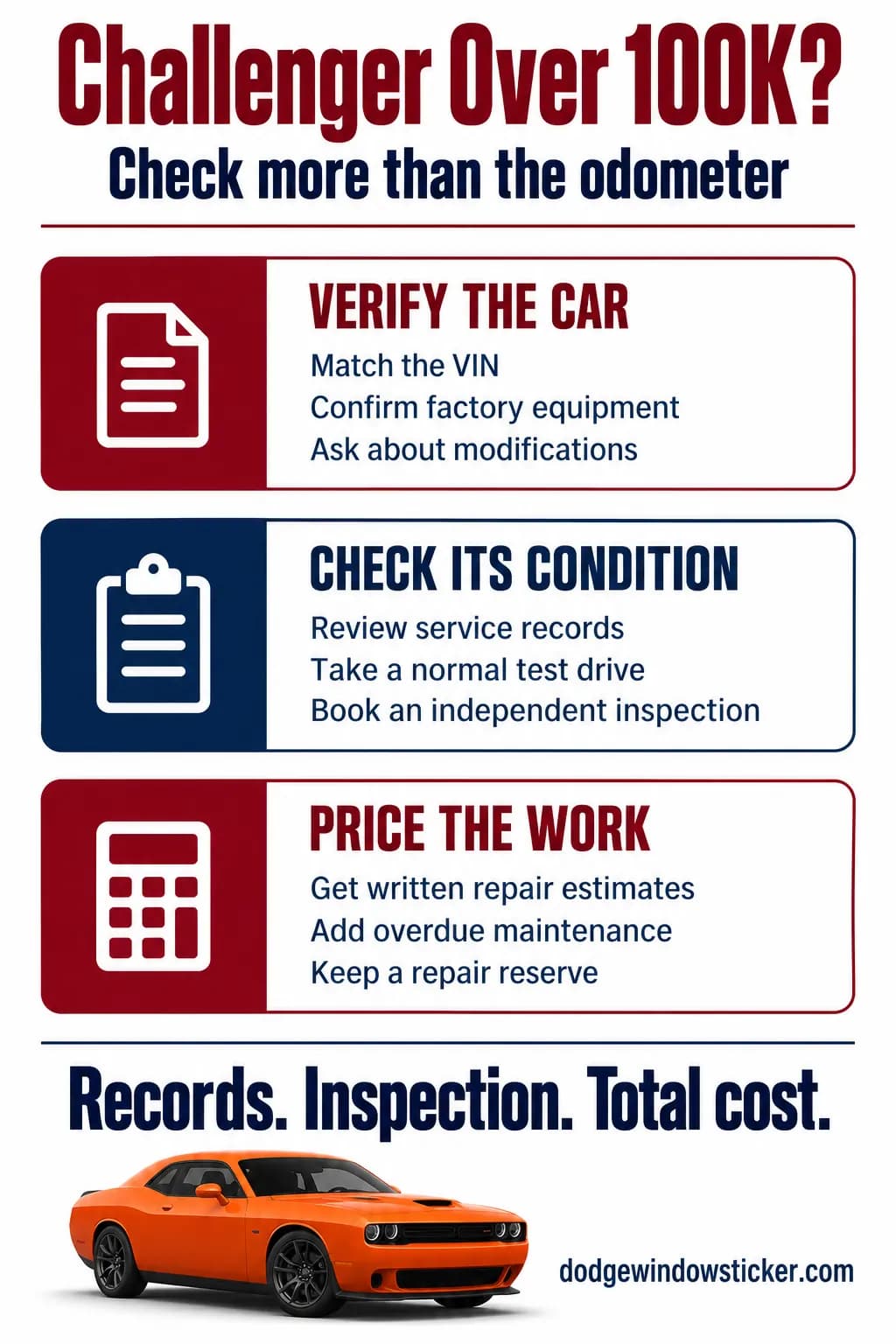
Use your records and inspection to make the final decision. A high-mileage Challenger can need ordinary wear items without being unsuitable, but the work must fit your budget and plans.
| Worth Considering | Reason to Pause |
|---|---|
| The seller’s account matches the documents | Important mileage or ownership questions remain unexplained |
| Inspection identifies manageable work | A major problem has no reliable diagnosis or estimate |
| Maintenance needs are clear | “Fully serviced” claims lack supporting details |
| Modifications are documented and assessed | Significant changes remain unexplained |
| Total cost leaves a repair reserve | The purchase would leave no money for necessary work |
← Scroll horizontally to see more →
If you need the car immediately for commuting, unfinished repairs matter more than they would on a weekend project. For questions about keys, removable accessories, and what the seller will hand over, you can read about what a Dodge window sticker shows and what it doesn’t. Before paying, put any promised repairs or supplied parts in writing. Identify the work, who will complete it, and when it will be ready.
Let the Condition Direct Your Decision, Not Just the Mileage
Buying a Dodge Challenger with over 100,000 miles deserves a decision based on records, inspection, and cost. Start with its original configuration, establish what maintenance it needs, and decide whether the complete purchase fits your circumstances. If the evidence is incomplete, keep asking or keep looking