
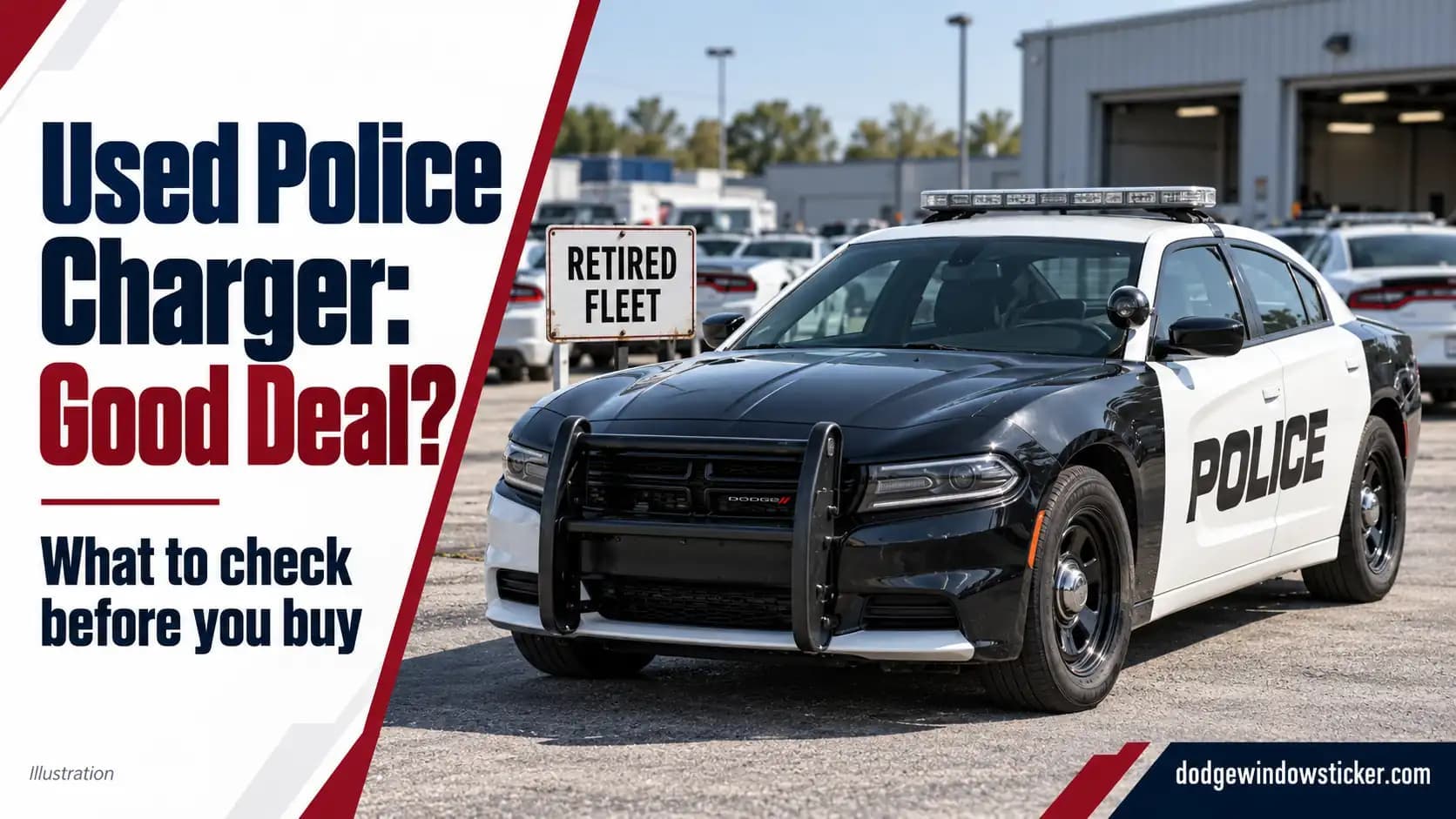
A used Dodge Charger police car can be worth buying if its records, condition, and total cost make sense. A low asking price alone is not enough. Check engine hours, maintenance, and what was changed when the car left police service.
For someone who wants a Charger and can budget for repairs, the right example deserves a look. For someone who needs dependable transport immediately, a car with missing records or unfinished work is a harder choice.
Key Takeaways
- Compare mileage with engine hours and maintenance records.
- Confirm the factory equipment, then inspect what remains today.
- Price the car with repairs and missing parts included.
Is a Retired Police Charger Right for You?
Start with how you plan to use the car. A project you can leave at a workshop is different from your only way to get to work.
| Your situation | What should matter most |
|---|---|
| You need an everyday commuter | Inspection results, comfort, and immediate repair needs |
| You regularly carry passengers | Rear door operation, seat belts, seats, and windows |
| You want a weekend project | A clear list of work and a realistic repair budget |
| You are mainly attracted by the price | The total cost compared with other available Chargers |
← Scroll horizontally to see more →
Do not assume “police package” means a better car for every owner. Equipment intended for police work may offer little benefit for your commute, while missing comfort features could matter every day.
Before looking at listings, write down three essentials. These might be working air conditioning, usable rear seats, and enough money left for maintenance. Keep those priorities ahead of the car’s appearance.
Find Out What Work the Charger Actually Did
A seller may describe a Charger as a patrol car, an unmarked vehicle, or a supervisor’s car. Those descriptions are useful questions to investigate, not condition grades.
Ask for:
- The previous agency or fleet owner, if known.
- The vehicle’s reported assignment.
- Available maintenance and repair records.
- Its retirement or sale date.
- Any work completed since it left service.
“Supervisor car” sounds reassuring, but the label alone does not establish gentle use. Ask what supports the description and compare it with the records. Fleet ownership can be useful when service documentation is available. However, “fleet maintained” without invoices or a maintenance log leaves you relying on the seller’s account.
If the car passed through another owner after retirement, request records for that period too. An older agency service file does not explain everything that happened afterward.
Why Mileage Is Only Part of the Picture?
An odometer records distance. An engine can also run while the car is stationary, so a police Charger’s mileage does not tell the whole usage story.
Where available, ask to see the vehicle’s engine-hour readings:
| Reading | What it helps you understand |
|---|---|
| Odometer | Distance traveled |
| Total engine hours | Recorded time with the engine running |
| Idle hours | Recorded time spent idling |
← Scroll horizontally to see more →
Confirm which reading you are viewing. Total hours and idle hours are different measurements; do not treat them as interchangeable. Dodge’s 2023 Charger owner’s manual includes engine run time in its oil-change limits and specifically notes its relevance to fleet customers. Use the maintenance guidance for the actual model year and police configuration.
Avoid choosing a car using a universal “safe” idle-hour number. Hours need context: servicing, the vehicle’s condition, and the inspector’s findings. Likewise, do not turn an online hours-to-miles shortcut into a prediction of remaining engine life. Ask whether the maintenance records account for the way the car was used.
How a Dodge Window Sticker Helps Before the Viewing?
A seller’s equipment description can be vague. A vehicle-specific factory record gives you a clearer starting point for checking what the Charger was originally configured with.
A Dodge window sticker can help you compare available original equipment information with the listing:
| Seller’s Claim | What to Compare |
|---|---|
| A particular engine | The engine description in the vehicle’s factory record |
| All-wheel drive | The recorded drivetrain |
| A named package | The package listed for that VIN |
| Specific comfort equipment | Available standard and optional equipment details |
← Scroll horizontally to see more →
Do not infer the drivetrain or engine just from “Pursuit.” Check the exact vehicle and model year. You can check the sample and available coverage on the Dodge window sticker lookup page. Confirm that the record supports the details you need before ordering.
The sticker helps investigate factory configuration. It does not establish the car’s police assignment, maintenance quality, or current condition. Equipment fitted by an agency after delivery may require separate records.
Check What Changed When Police Equipment Was Removed
Preparing a police Charger for resale involves more than taking off decals. Radios, partitions, lights, and other equipment may have been added during service and removed afterward.
Ask what was removed, who did the work, and whether an invoice is available.
| Area | What to look for during the viewing |
|---|---|
| Dashboard and center console | Missing panels, exposed mounting points, or unfinished openings |
| Roof and bodywork | Former equipment holes and how they were sealed |
| Trunk | Loose wiring, brackets, or missing trim |
| Interior | Removed partitions, seat changes, and damaged fittings |
| Ordinary controls | Lights, locks, windows, and audio functions that need checking |
← Scroll horizontally to see more →
These observations help you identify questions for an inspector. They are not a substitute for checking wiring or repair quality.
Do not accept “that is normal on police cars” as the complete explanation for something that does not work. Ask whether the feature was intentionally disabled, removed, or is faulty.
A neatly cleaned cabin is welcome. What matters more is whether the vehicle has been properly prepared for the way you intend to use it.
Will the Rear Seats Work for Everyday Passengers?
Before choosing an ex-police Charger as a family car, inspect the rear passenger area carefully.
Dodge’s 2023 police supplement describes an optional configuration with rear doors that cannot be operated from the rear seats and rear windows controlled from the driver’s switch. This does not apply to every Charger. For the car you are viewing, confirm:
- Whether rear passengers can open the doors normally.
- Whether rear window controls work as expected.
- Whether seats and seat belts are complete and suitable.
- Whether any partition or other police equipment remains.
Have the seller demonstrate the arrangement without putting anyone in a situation where they cannot get out. Ask a qualified shop about any restoration work needed. If parts were replaced after retirement, ask for supporting records and an inspection. A replacement rear seat alone does not establish that the passenger area is ready.
For broader questions about removable items and sale inclusions, you can find out if a Dodge window sticker shows everything included with the car.
Read the History Alongside the Service Records
Performing a Dodge VIN check can help you investigate available title, mileage, ownership, and damage records. Coverage varies, so treat the report as one part of the evidence. Compare entries with the seller’s timeline. A repair invoice, auction description, and history report should describe the same vehicle without unexplained contradictions.
| If You Find… | Ask For… |
|---|---|
| A recorded collision | Repair records and an inspection of the repaired area |
| Mileage that does not fit the timeline | An explanation supported by documents |
| A gap after fleet retirement | Records from the later owner or dealer |
| A title issue | The actual title and clarification before proceeding |
← Scroll horizontally to see more →
A clean report does not prove that every incident was recorded. Nor does a report measure present engine health. Save copies of the records you rely on. If the seller offers only a cropped screenshot, request the complete relevant document so dates, VIN, and surrounding details are visible.
Arrange for a Professional Inspection
Tell a professional mechanic that the car is a retired police Charger before booking. Ask whether the shop is comfortable assessing former fleet vehicles, and for any removed equipment. Give the inspector your records and unanswered questions. Useful inspection priorities include:
| Priority | Why it matters to the purchase? |
|---|---|
| Engine operation and leaks | Helps identify problems that paperwork cannot settle |
| Brakes, tires, and suspension | Establishes immediate work needed for ordinary driving |
| Added or altered wiring | Addresses concerns left by equipment installation or removal |
| Body condition and corrosion | Helps assess damage, deterioration, and previous repairs |
| Passenger equipment and controls | Checks suitability for your intended use |
← Scroll horizontally to see more →
Note that a history report does not replace an independent mechanical inspection. Ask for written findings and repair estimates, separating urgent work from cosmetic improvements. If the seller will not permit an inspection, you must decide without that evidence; a lower price does not remove the uncertainty.
Compare the Total Cost, Not Just the Asking Price
For a used police Charger, calculate the purchase price, buying fees, transport, immediate repairs, and missing parts. Then leave room for maintenance and unexpected work. That reserve should suit your finances and the inspection findings, rather than an arbitrary percentage.
Here is a hypothetical example, not a market-price estimate:
| Cost | Example |
|---|---|
| Purchase price | $8,000 |
| Fees and transport | $900 |
| Immediate repairs quoted by a shop | $1,600 |
| Missing interior parts | $500 |
| Starting cost before an additional reserve | $11,000 |
← Scroll horizontally to see more →
Use the same cost categories when comparing another Charger. Comparing one car’s complete starting cost with another car’s advertised price would be misleading.
Get a vehicle-specific insurance quote before committing. Also confirm any purchase, transport, or registration requirements with the relevant seller or authority rather than assuming the car is ready to drive away.
Pro tip: Get prices for missing parts before negotiating. An empty console area or damaged trim is easier to assess when you know what restoring it will cost.
What to Do If You Are Buying at Auction?
Read the listing and auction terms before placing a bid. Establish whether you can inspect the car, start it, arrange a test drive, or use an independent inspector. Check the payment deadline, buyer fees, collection window, and transport arrangements. Ask which documents and keys will be supplied.
If inspection access is limited, mark the unresolved condition questions in your budget. “Runs and drives” is not a detailed assessment of reliability or roadworthiness. Set a maximum bid using the complete starting cost. Once bidding rises above that limit, the reason you considered the car inexpensive may no longer apply.
When to Buy and When to Walk Away

A former police Charger deserves consideration when the evidence supports the purchase. You do not need a perfect-looking car, but you do need an understandable deal.
| Worth Considering | Reason To Pause Or Walk Away |
|---|---|
| Records support the seller’s account | Important claims keep changing |
| Inspection identifies manageable work | Significant problems remain unexplained |
| Passenger equipment suits your needs | Essential restoration work is unpriced |
| Total cost leaves a repair reserve | Buying it would use your entire budget |
| Vehicle and paperwork match | VIN or ownership documents do not match |
← Scroll horizontally to see more →
An unanswered question about cosmetic trim is different from uncertainty about ownership, safety, or a major repair. Prioritize the issues that could prevent you from using the car.
Choose the Car You Can Verify and Afford
Buy a used Dodge Charger police car because the specific vehicle passes your checks and fits your budget. Use factory equipment records to clarify the listing, history records to investigate its past, and an inspection to judge its present condition. If essential questions remain unresolved, keep looking.
FAQ About What to Do Before Buying a Used Dodge Charger Police Car
Does a police Charger automatically have a V8?
No. Do not use the police badge, bodywork, or seller’s wording to identify the engine. Check the VIN-linked factory equipment information for the specific Charger, then have the vehicle inspected if anything differs. Police use does not establish one engine, drivetrain, or equipment combination across all model years and vehicles.
Does regular fleet servicing guarantee a reliable used car?
No. Service records can show work performed, but they cannot guarantee what will fail next. Check that the records belong to the Charger, cover its service period, and explain major repairs. Combine that history with an independent inspection and a repair budget suited to your planned use and financial circumstances.